
Your shopping cart is empty!
Paw Balm for Dogs: When It's Needed and How to Apply It Properly
A dog's paw pads look tough and resilient — which is precisely why owners assume "nothing will happen to them." Veterinary data says otherwise: when the air temperature reaches +30°C, asphalt heats up to +57°C and can burn paws within minutes (AKC / Dr. Jerry Klein, DVM, 2026). In winter it's the reverse — salt, de-icing chemicals, and dry indoor heating air make pads brittle in a week or two. Paw balm isn't a cosmetic for toy breeds or a "trendy" product. It's a working tool for protection during four to five months of the year.
Paw balm is needed in two key situations — winter (against salt, de-icers, and dryness) and transitional seasons (crack prevention). In summer on hot asphalt, balm has limited efficacy — it melts and doesn't protect against temperature; the better solution is shifting walk timing to morning and evening and choosing grassy routes. The right formula: natural waxes (beeswax, lanolin) plus nourishing oils (shea, cocoa, coconut).
Why Dog Paws Need Separate Care
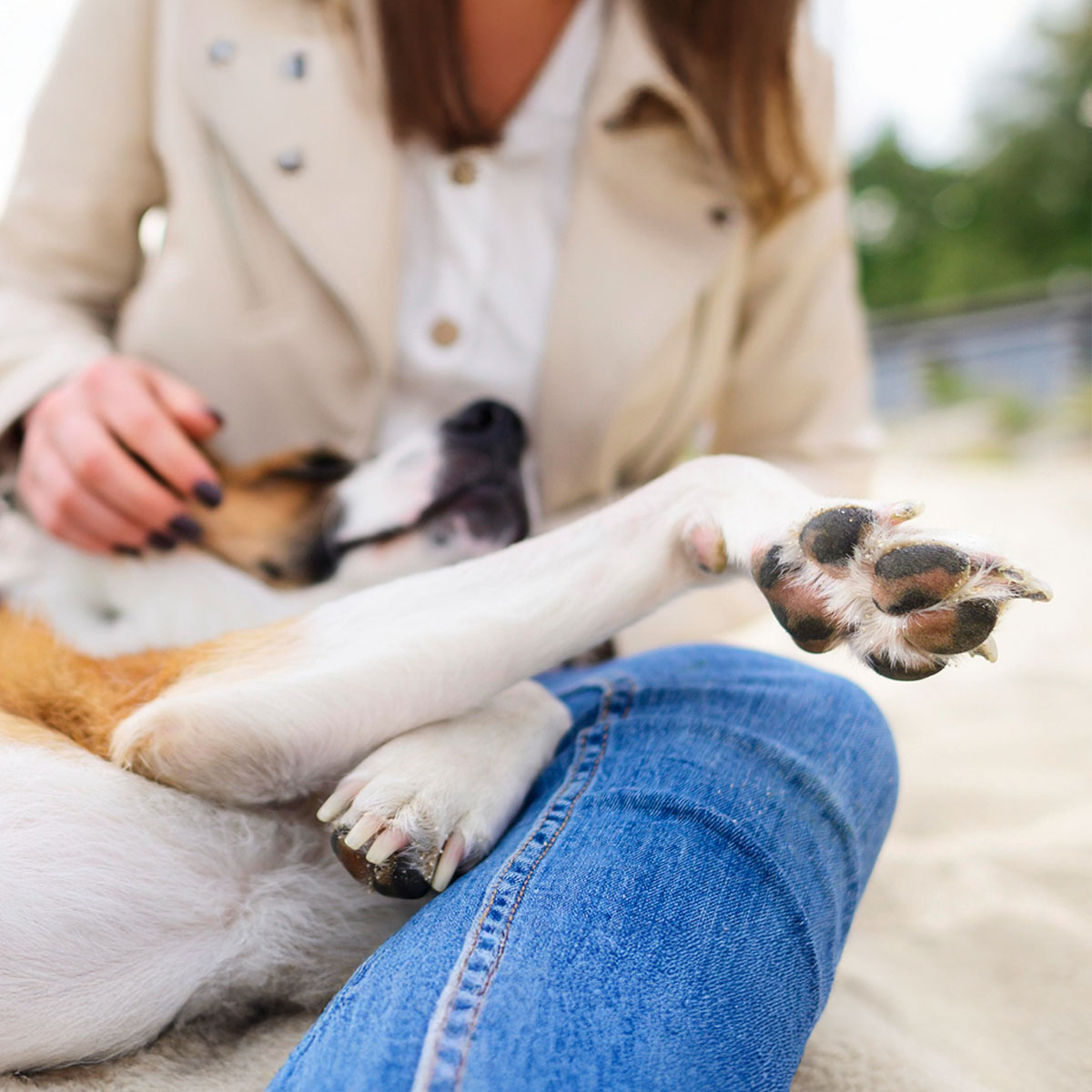
A dog's paw pad looks like a "callus," but structurally it's a complex tissue of several layers of keratinized skin and a fat pad, interlaced with a network of nerves and blood vessels. Research published in the British Journal of Pharmacology showed that dog paw pads contain one of the densest sensory networks in the body — the animal literally "reads" the ground through its feet (Bell C, Lang WJ). That's why even a small cut or crack causes lameness disproportionate to the size of the injury.
Paw pads perform five functions simultaneously:
- Shock absorption. The fatty layer of the pad absorbs impact, reducing load on the joints.
- Thermoregulation. Dogs don't sweat through their skin — it's through paw pads (where sweat glands are located) that limited body cooling occurs.
- Traction and grip. The rough texture prevents slipping on natural surfaces.
- Tactile information. The dog senses the character of a surface: temperature, moisture, vibration.
- Protection of internal structures. The keratinized layer is a shield for the vessels, tendons, and bones of the foot.
When a pad is damaged — all five functions suffer at once. The dog starts redistributing weight, increasing load on the healthy paws, licks the pad and introduces bacteria into microcracks, and gradually loses confidence in walking. That's why balm prevention is not "aesthetics" but functional health.
A dog's paw pads are not just a "callus" but complex tissue made of keratinized skin, a fat pad, nerve endings, and sweat glands involved in thermoregulation (Spectrum of Care, 2026). This is why even a small crack or burn causes disproportionately severe lameness.
What Actually Harms a Dog's Paw Pads: 6 Factors
Understanding the threats is the first step to choosing the right protection strategy. The same balm isn't needed every day of the year — it works against specific challenges.
1. Winter salt and chemical de-icers
The main enemy of paws in winter isn't the cold — it's the substances used to treat roads. Rock salt (sodium chloride) and modern de-icers (calcium chloride, magnesium) destroy the lipid barrier of paw pad skin. Cracks form within 1–2 weeks of regular walks. These substances are also toxic when licked off — dogs coming back from a walk lick de-icer residue and get irritation of the mouth and stomach lining (Spectrum of Care).
2. Hot summer asphalt
According to AKC data and the Journal of the American Medical Association, at an air temperature of +30°C asphalt can heat up to +57°C, and at +32°C — to +65°C. Paw pad burns start at +52°C and leave blisters, cracks, and peeling of the horny layer. The seven-second rule: press the back of your hand to the asphalt — if you can't hold it for seven seconds, the asphalt is dangerous for your dog.
3. Ice, hardpack snow, and frozen puddles
A sharp ice edge will cut a paw pad just as glass would. Hardpack snow (a dense icy crust over snow) is a common cause of deep paw cuts in toy breeds and puppies. A wet cold surface plus salt is an ideal combination for cracking.
4. Sharp objects on walks
Broken glass, gravel, small twigs, metal debris — standard threats in the city and beyond. Puncture wounds (from nails, thorns) are especially dangerous: the wound looks small but drives infection deep into the tissue.
5. Household chemicals at home
Floor cleaners, disinfectants, bathroom cleaners — all remain on the floor until fully dry. The dog walks on the freshly cleaned floor — and chemicals end up on the pads, from where they go into the mouth during licking.
6. Dry indoor air in winter
Indoor heating reduces air humidity in apartments to 20–30% (normal is 40–60%). This dries out skin — not just for humans, but for dogs too. Pads lose elasticity, small cracks appear — even without going outside.
At +30°C air temperature, asphalt heats up to +57°C, which is above the burn threshold for a dog's pad (AKC / Dr. Klein, DVM, 2026). This means that even a short midday summer walk carries a real risk of chemical and thermal burn at the same time.
When Balm Is Actually Needed — 5 Scenarios
Not every owner understands when balm makes a difference and when it doesn't. Here are the specific scenarios where it's justified.
Scenario 1. Winter season and road salt
This is the primary use case. Apply balm 15 minutes before going outside — it creates a thin protective film between the pad skin and chemical de-icers. After coming home — mandatory rinse of paws with warm water and reapplication of balm to restore the skin. Period: from November through the end of March, before every walk.
Scenario 2. Transitional seasons — when the skin is "between states"
Autumn and early spring are the times when paw pad skin isn't yet adapted to seasonal challenges. In autumn it's still soft and summery, but already exposed to cold; in spring — the opposite, after winter cracks it hasn't yet recovered. Preventive balm application 2–3 times a week helps avoid deep damage.
Scenario 3. Active walks and hiking
Long hikes, cross-country running, gravel play — all of these create abrasive stress on paw pads. Balm applied before activity works as a lubricant, reducing friction and the risk of calluses forming. Applied after — it speeds recovery of microtraumas.
Scenario 4. After microtraumas and dry pads
If small cracks, dry crusts, or a slightly "rough" surface have appeared on the pads — balm is the first line of care. Nourishing oils in the formula restore the hydrolipid balance; wax creates a barrier film under which the skin "bakes" more effectively.
Scenario 5. Indoor and toy breeds
Dogs that rarely go outside paradoxically have more sensitive pads — they don't have time to "toughen up." Same for toy breeds (Maltese, Yorkie, Toy Poodle) with soft paws. For them, balm is regular care even without extreme seasonal challenges. 1–2 times a week is enough.
When Balm Isn't a Cure-All (and What to Do Instead)
Here it's important to be honest: balm isn't universal protection. There are situations where it either doesn't work or is contraindicated altogether.
In summer on hot asphalt, balm doesn't help
This is important. Balm is made on a wax base that starts softening at +35–40°C. On asphalt heated to +50°C or more, it simply melts — and doesn't form a protective film. Retail chains PetSmart and Mud Bay explicitly warn: "balm doesn't protect against asphalt temperature" (PetSmart). What actually makes a difference in summer: shifting walk times to early morning (before 9:00) and evening (after 20:00), choosing grass or dirt routes instead of asphalt, shortening the duration of walks during the hottest part of the day.
For a deep wound, balm can't replace a vet
If a pad is severely cut, you can see fatty tissue, bleeding hasn't stopped for over 10 minutes, or the dog isn't putting weight on the paw at all — this is for the doctor. Balm over a deep wound creates a greenhouse effect and promotes infection. First — antiseptic and vet consultation, balm only during the healing stage.
For fungal or bacterial infections — specialized treatment
Yeast infection of the pads gives a "sweet" smell and brown skin discoloration. Bacterial — swelling, pus, foul odor. Here you need antifungals or antibiotics, not balm. A nourishing film can actually worsen the condition by creating a closed moist environment for pathogen growth.
For chronic licking, find the cause
Is the dog constantly licking the same paw? This isn't a "habit" — it's a signal: allergy, atopic dermatitis, foreign body in the interdigital space. Balm will mask the symptom without solving the cause. See a vet — mandatory.
Retail chains PetSmart and Mud Bay explicitly warn: paw balms lose their protective properties on hot asphalt, so for summer walks at air temperatures above +25°C shifting walks to morning and evening and choosing grass routes is more effective (Mud Bay, 2025). This is the honest boundary of balm's functionality — its purpose is protection against chemicals, friction, and dryness, not against extreme temperature.
How to Choose a Paw Balm — 4 Criteria
The market offers dozens of balms — from expensive "luxury" to homemade "natural." Here are the criteria that really determine effectiveness.
1. Transparent and functional composition
A working paw balm is built on three components:
- Solid oils and waxes — shea butter (Butyrospermum Parkii), cocoa butter (Theobroma Cacao), coconut oil, beeswax. They form a dense film.
- Liquid oils — olive, grape seed oil. They nourish and moisturize.
- Functional ingredients — lanolin (softens, promotes healing), vitamin E (antioxidant).
This is exactly the composition of PURAMUR WOW Protector Balm 50 ml: shea butter, cocoa butter, olive oil, grape seed oil, beeswax, lanolin, coconut oil, vitamin E. For home use — the optimal volume.
2. No toxic ingredients
The same principles as with perfumes (see our article on dog perfume safety): the composition should not contain concentrated essential oils from the list toxic to dogs — tea tree, cinnamon, peppermint, citrus, ylang-ylang. A balm that a dog might lick off the pads must be safe upon minimal ingestion.
3. Ideally, pet-safe labeling
Products specifically designed for animals undergo tolerability testing. This distinguishes them from "human" hand balms, where compounds neutral to humans (like xylitol) may be present but are toxic to dogs.
4. Form of packaging
Three main options: jar (classic, for regular use), stick (compact, for travel), tube (hygienic). For home use, a 50 ml jar is the optimal volume: it lasts 3–6 months of regular application and doesn't lose properties before it's used up.
How to Apply Balm — Step by Step
Mistakes in application reduce product effectiveness dramatically. Here's how experienced groomers do it.
- Step 1. Prep the paws. Wash with warm water, dry thoroughly. Especially carefully — the interdigital space. Balm goes on unevenly on wet skin and isn't absorbed.
- Step 2. Take the right amount. On each pad — pea-sized. For a medium dog — about ¼ teaspoon for all four paws combined. More won't improve protection, only increase the risk of getting the floor dirty.
- Step 3. Apply with a massaging motion. Rub into pads and interdigital space with circular movements until nearly fully absorbed. This improves circulation and ensures even distribution.
- Step 4. Don't forget the nose. WOW Protector, like most quality balms, also works for the nose — same formula, same principle. Especially relevant for brachycephalic breeds (Pugs, Bulldogs, Boxers), whose noses often dry out.
- Step 5. Distract the dog for 10–15 minutes. During this time the balm will absorb. Play, offer a chew, or go for a walk — so the dog doesn't lick the product off before it absorbs.
- Step 6. Follow the routine. Winter — daily before walks. Transitional seasons — 2–3 times a week. Summer — only before activity or at night, for recovery. Overuse doesn't work better than normal use in any regimen.
Common Mistakes When Using Balm
Balm effectiveness is often "ruined" not by poor composition but by poor technique. Here are the six most common missteps.
- Applying to dirty paws. Sand, salt, chemical residues stay under the protective film and continue irritating the skin.
- Letting the dog lick it off immediately. Balm works when absorbed. If the dog licks it off in 30 seconds, you're just wasting product.
- Using in summer as the sole heat protection. Balm melts on asphalt above +40°C. In summer it works for nighttime recovery, not for midday walks.
- Applying to deep wounds. Isolates bacteria inside the wound instead of letting it breathe. First antiseptic and vet — then balm.
- Skipping the interdigital space. This is the most sensitive area, where salt and dirt linger the longest. Always rub balm in there too.
- Using human hand cream. Many human creams contain xylitol, which is lethally toxic to dogs, and fragrance compounds from the list of prohibited essential oils. Don't cut corners on a pet-safe product.
What's often overlooked: the nose and paw pads react to the same irritants — dryness, wind, de-icers, UV. So if you're applying balm in winter, apply it to the nose at the same time (for brachycephalics this is especially relevant: flat faces suffer more from dryness). One procedure — two effects.
Frequently Asked Questions About Paw Balm for Dogs
How long does balm last after application?
Protective effect — 2–4 hours after application, depending on the dog's activity and surface. The wax and oil film gradually wears off through contact with asphalt, snow, water. That's why in winter it's recommended to apply balm before every walk; for all-day activity — twice a day.
Is it safe for puppies?
Yes, from 8–10 weeks of age. Puppy pads are especially soft and sensitive, so regular balm application helps adapt the skin to loads. The main thing is to make sure the formula is pet-safe and doesn't contain essential oils from the toxic list. A formula like PURAMUR WOW Protector on natural oils and waxes is suitable for puppies too.
What if the dog eats the balm?
With a quality pet-safe balm, a small amount (what the dog managed to lick off the paws) isn't dangerous. At most — a mild digestive upset. If the dog got to the whole jar and ate a significant portion — vomiting and diarrhea are possible from the large amount of fats. Provide water; if symptoms persist — see a vet.
Can I use human hand cream instead?
Absolutely not. Human creams often contain: xylitol (lethally toxic to dogs even in small doses), essential oils from the toxic list (tea tree, mint, citrus), parabens, and phthalates. The risk doesn't justify the savings — a pet-safe balm is affordable and completely safe upon licking.
How do I know the balm is working?
Signs of proper protection: pads remain elastic after winter walks, no cracks or dry crusts appear, the dog doesn't lick paws immediately upon returning home. If after 2 weeks of regular use paws still crack — review the product composition or consult a vet: a dermatological cause is possible.
Key Takeaways About Paw Balm for Dogs
Paw balm isn't an accessory for toy breeds or a "trendy" product. It's a working tool that solves specific tasks during four to five months of the year: protection against winter salt, prevention of transitional-season cracks, support during active walks. In summer its role is limited — here you need other solutions: changing routes, morning and evening walks, shortening active time in the heat.
What to remember:
- Balm is critically needed in winter (daily) and transitional seasons (2–3 times a week); in summer — limited, for nighttime recovery.
- In summer on asphalt above +40°C, balm melts and doesn't protect — the answer is shifting walk times to morning and evening hours and choosing grassy routes.
- The right composition: natural oils (shea, cocoa, coconut, olive), waxes (beeswax, lanolin), vitamin E. No essential oils from the list toxic to dogs.
- Apply to clean dry paws, rubbing in with massage for 10–15 minutes until absorbed. Don't forget the interdigital space and nose.
- Balm doesn't replace the vet for deep wounds, infections, and chronic licking — diagnosis is needed there.
- Human hand creams — absolutely no: xylitol and toxic oils in the composition.
If you're looking for a pet-safe balm with a working composition — check out PURAMUR WOW Protector for paws and nose 50 ml: shea butter, cocoa butter, olive oil, grape seed oil, beeswax, lanolin, coconut oil, vitamin E. The volume is enough for 3–6 months of regular home use. Healthy paw pads are not just about appearance — they're the foundation of your dog's mobility for years to come.