
Your shopping cart is empty!
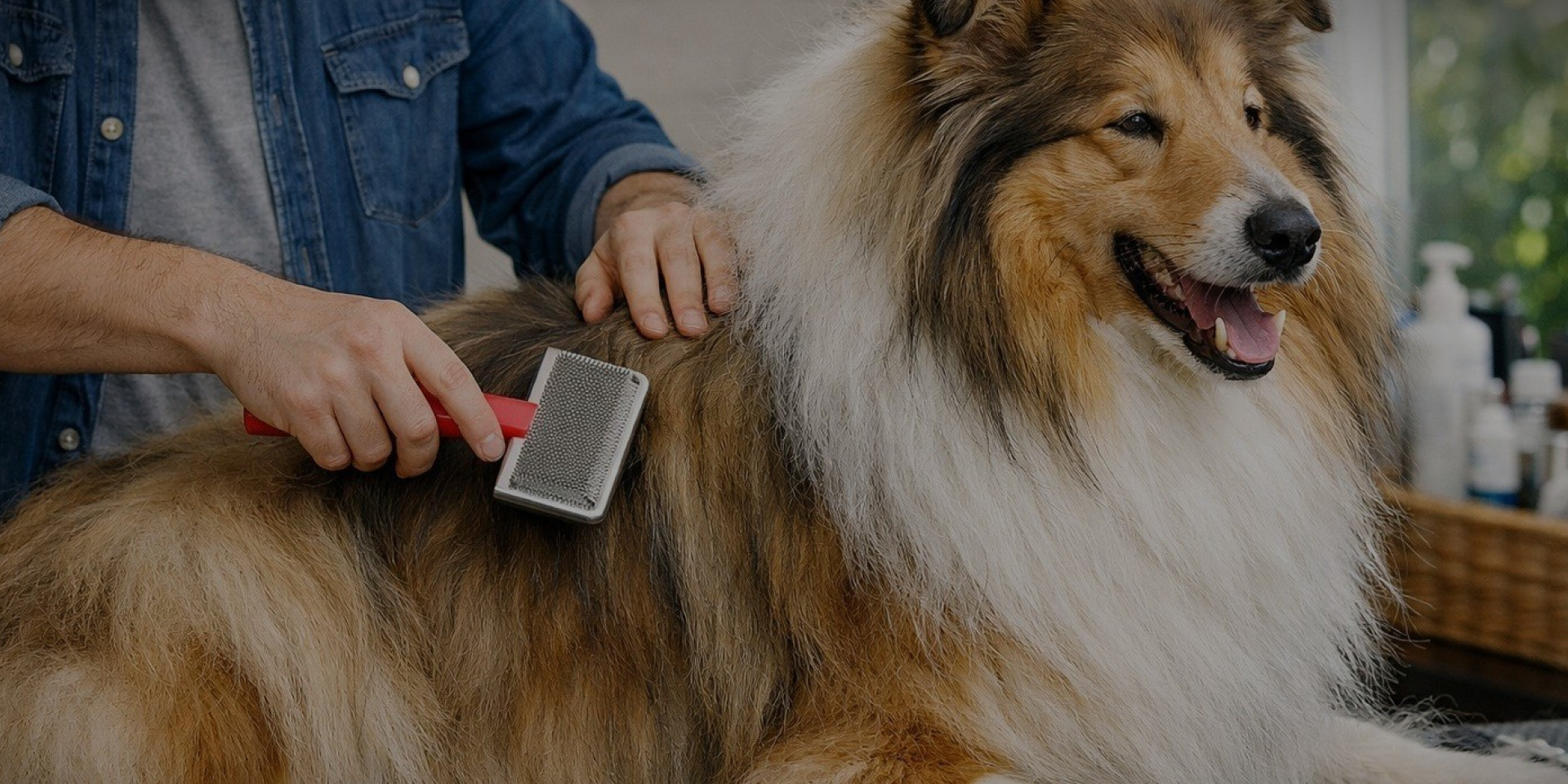
A Fist-Sized Mat: Why It Appeared in a Week and How to Remove It Without Tears (Yours and Your Dog's)
You just dealt with a mat — and a week later you found the same one, only bigger. This isn't a coincidence or "poor grooming" — it's a pattern. According to grooming salon Wagabonz (2022), around 75% of doodles and poodles that come in for a haircut have mats or full coat matting that requires a complete shave-down. For curly and long-haired breeds, the first small knots can appear in just 2–3 days without brushing; within a week — a fist-sized mat.
Even worse: a large mat isn't just "unsightly." It pulls on the skin with every movement, blocks airflow, and becomes a breeding ground for bacteria. Your dog may be experiencing chronic discomfort for weeks — and you won't even notice until you touch the right spot.
This article covers 7 specific reasons mats form so fast, a step-by-step guide for painless home removal, and a grooming schedule that will keep them from coming back.
In short: For long-haired and curly breeds, a fist-sized mat can form in 5–7 days without brushing — especially after bathing or from harness friction. To remove at home: apply a detangling spray, hold the fur with your fingers near the root, and work from the ends toward the base. Severe mats — go to a groomer, not scissors.
What Is a Mat and Why It's Not Just "Messy Fur"
A mat is a dense tangle of live and dead hairs that traps dust, sand, plant seeds, and dead skin. According to VCA Animal Hospitals (2024), matted areas completely block skin ventilation, trap moisture after rain or bathing, and create ideal conditions for acute moist dermatitis — hot spots, one of the most common skin conditions in dogs.
What happens under a mat — specifically:
- Skin can't breathe; local temperature under the mat is several degrees higher
- Moisture is trapped for hours after a walk in the rain
- Every movement pulls on the skin — this is constant low-grade pain
- In neglected cases — abrasions, deep wounds and swelling where the mat presses
- In severe cases: dense matting can compress limbs, restrict blood flow and lead to tissue necrosis — according to PMC and ASPCA Pro (2022), cases have been documented where amputation was the result
Worth knowing: A mat pulls on the skin with every step. Some dogs described as "suddenly aggressive" or "avoiding touch" are simply suffering from chronic pain due to neglected coat. Before looking for behavioral causes — check the coat.
When you need a vet, not a groomer: if there is redness, a moist crust, or an unpleasant smell under the mat — this is treatment, not grooming. According to Cornell University College of Veterinary Medicine (2023), hot spots (acute moist dermatitis) develop in 15% of all dogs during their lifetime, and most commonly in thick-coated breeds prone to matting. It is impossible to identify and treat them without first removing the mat.
Mats aren't just an aesthetic problem: dense matted fur completely blocks skin ventilation, traps moisture, and creates conditions for acute moist dermatitis. In 15% of dogs hot spots will develop at least once in their lifetime, and chronic matting multiplies this risk many times over (Cornell University, 2023). A mat is always the first point to check when skin symptoms appear.
7 Reasons Why a Mat Grew to the Size of a Fist in Just One Week
Practical data from Wagabonz (2022) describes the timeline clearly: after 1–2 days without brushing in friction zones, the first small knots appear. After 3–4 days they tighten into early mats that are already hard to untangle without tools. After 5–7 days in poodles, doodles, or Maltese — a noticeable fist-sized lump in the armpit or behind the ear, tender to the touch. But it's rarely just about missed brushing sessions. There are accelerators that make this process happen twice as fast. Do you know which one triggers it most often in your dog?
1. Bathing without drying and brushing afterward. Wet fur mats twice as fast as dry fur. If you only towel-dry after a bath — the undercoat will start clumping within a few hours. Groomers say without exception: blow-dry completely and brush immediately.
2. Collar or harness. Friction is the main catalyst. The area around the collar and under the armpits from the harness are the highest-risk zones. Every day fur gets tangled there from movement. A new accessory can cause the first mat in as little as 3–4 days.
3. Walking through grass and bushes. Plant seeds, burrs and dry stems catch on soft fur and immediately form the core of a future clump. One run through dry grass — and you have a reason to brush that same evening.
4. Shedding season. Undercoat that grows or falls out in spring and autumn doesn't "come out" on its own — it stays between the live hairs and mats with them. During this time the risk of mats doubles even with a normal grooming schedule.
5. Coat type. Soft, silky or curly fur mats much more easily than coarse straight fur. This isn't a lack of care — it's the physics of the hair surface. Poodles, doodles and Maltese are record-breakers for mat formation speed.
6. Dog's excess weight. Overweight dogs can't effectively groom themselves and can't reach their "blind zones" — the groin, the back of the body, the base of the tail. That's exactly where mats appear first and most often go unnoticed.
7. Static electricity in winter. Dry air from radiators charges the coat with static — hairs attract each other and clump together even without physical movement. A few drops of conditioner or an anti-static spray significantly reduce the risk. For winter prevention, groomers recommend PURAMUR Keratin & Ceramide Finishing Spray — it's leave-in and neutralizes static after every brushing session.
How to Remove a Mat at Home: 8 Steps Without Pain or Panic
First, assess the scale: if the mat is smaller than a walnut and you can fit a finger between it and the skin — handle it yourself using the 8 steps below. If it's larger than a fist, as dense as felt, or located between the legs — that's a job for a groomer with a clipper. Most early-stage mats can be removed in 10–15 minutes with the right technique.
Step 1. Never work on wet fur. Wet fur compresses even tighter when you try to untangle it. The dog must be completely dry before you start.
Step 2. Apply a detangling spray. Saturate the mat and wait 2–3 minutes. The spray reduces static and lubricates the hairs — everything that follows becomes much easier. PURAMUR Express Hair Protector fluid spray works well here — it contains hydrolyzed keratin and silk proteins, eliminates static and eases combing even through dense mats.
Step 3. Hold the fur between the mat and the skin. With two fingers — or a full hand for a large mat — firmly grip the fur right at the root. This "absorbs" the tension on the skin with every comb stroke. Without this step, it hurts.
Step 4. Start from the ends, work toward the root. Never pull from the root outward — it's painful and ineffective. Use small strokes to break up the outer layer of the mat and gradually work your way deeper.
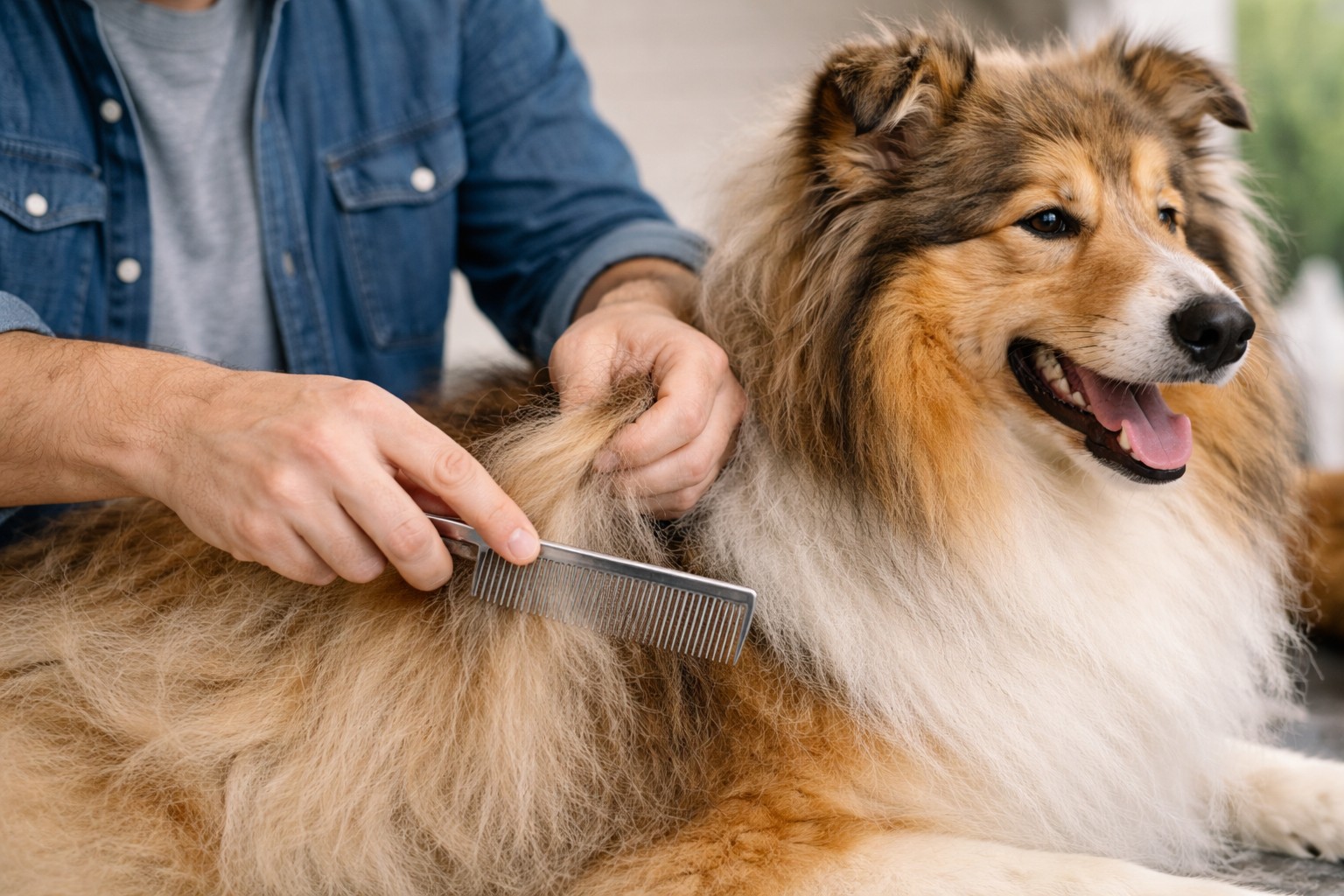
Step 5. For medium-density mats — use a dematting comb. A comb with curved teeth partially cuts through the hairs parallel to the skin without injuring it. It works where a regular comb gets stuck.
Step 6. Check with a metal comb. After untangling, run a metal comb from the skin outward. If it passes freely — the area is clear. If it catches — there's a hidden undercoat knot remaining.
Step 7. Don't use regular scissors. Scissors and mats are a dangerous combination: the fur pulls a fold of skin upward, and cutting the body is very easy. If trimming is unavoidable — only blunt-tipped scissors, parallel to the skin, with a finger between the blade and the body.
Step 8. Severe mat — go to a groomer. If the mat is large or as dense as felt — don't torture yourself or your dog. A groomer will remove it with a clipper: painlessly and in a few minutes.
From groomers' experience: Owners often try to cut through a large mat with scissors and accidentally cut the skin — the fur pulls the fold up and the blade slides. If the mat is larger than 4–5 cm and dense — an electric clipper in an experienced groomer's hands is safer and faster than any home solution.
Removing dense mats with an electric clipper is the safest method for large and neglected cases. Attempts to cut with scissors are dangerous: fur pulls the skin upward, the risk of a cut is real. Scissors are only acceptable if they are blunt-tipped, held parallel to the skin, with a finger as a barrier between the blade and the body (PetMD, 2024). In difficult cases — go to a groomer.
Which Tools You Actually Need (and What's Not Worth Buying)
A slicker brush is the most basic and vet-recommended tool for prevention and untangling light knots. But one brush doesn't solve everything. Most mat problems stem from cheap brushes that glide along the top layer of fur and never reach the undercoat — and owners are genuinely puzzled why there are no results.
| Tool | Purpose | Priority |
|---|---|---|
| Slicker brush | Daily brushing, prevention | ★★★ essential |
| Metal comb | Final check, detecting hidden knots | ★★★ essential |
| Dematting comb | Breaking up medium-density mats | ★★☆ recommended |
| Detangling spray | Easier brushing, static reduction | ★★☆ recommended |
| Blunt-tipped scissors | Last resort — small careful trimming only | ★☆☆ use with caution |
| Electric clipper | Severe dense mats that can't be untangled | ★★☆ or go to a groomer |
What's not worth buying: cheap plastic brushes with ball-tipped pins — they slide along the top layer and never reach the undercoat. Also "magic" combs "for all coat types" and "2-in-1" sets — they usually fail at every specific coat type. Tools that actually work cost a little more but last for years.
A Grooming Schedule That Keeps Mats From Coming Back
Three weeks of regular brushing — and you'll feel the difference. According to groomers and vets, dogs with long or curly coats need brushing at least 3–4 times a week and professional grooming every 4–6 weeks (Dogster, 2025). Frequency depends on coat type — see the chart below.
Weekly minimum for high-risk zones:
- Twice a week — full brushing with a slicker brush from skin outward
- Once a week — check with a metal comb behind the ears, under the armpits, in the groin, around the collar and at the base of the tail
Post-bath protocol — always follow these three steps:
- Blow-dry to complete dryness — towel-drying is not enough
- While drying, brush immediately: use a slicker brush following the direction of the dryer
- After fully dry — metal comb from skin outward across the entire body
What owners say: Those who switch to the "brush while drying" protocol report a 60–80% reduction in mats within the first month. The hardest step is actually blow-drying all the way to the end instead of "mostly dry." But that's precisely the key step most people don't know about.
Regular brushing is the only proven method for mat prevention. Long-haired breeds need a minimum of 3–4 sessions per week and professional grooming every 4–6 weeks (Dogster, 2025). Those who wait for "visible signs" before brushing — are already too late.
PURAMUR products for prevention and care:
- Express Hair Protector fluid spray 200 ml — apply to dry coat before brushing; makes brushing easier, eliminates static, protects from damage
- Keratin & Ceramide Finishing Spray 200 ml — leave-in, anti-static effect after blow-drying
- Super Shine conditioner 200 ml — restores and adds shine after bathing, reduces clumping risk
Frequently Asked Questions
Can a fist-sized mat be removed at home?
If the mat is smaller than a fist and you can fit a finger between it and the skin — yes, using the 8 steps from this article. If it's large, as dense as felt, or located between the legs — it's safer to go to a groomer with a clipper. Attempting to cut with scissors without experience can damage the skin: fur pulls folds upward, and cutting is easier than it looks.
How long without brushing does it take for a large mat to form?
Based on practical data (Wagabonz, 2022): in poodles, doodles and Maltese, the first knots appear in 1–2 days, an early mat in 3–4, a noticeable fist-sized lump in 5–7 days. In a Golden Retriever — 2–3 weeks. Moisture and friction from a harness speed up the process twofold.
Is it painful for a dog to have a mat?
Yes, and this is confirmed by vets. A mat constantly pulls on the skin with every movement — meaning the dog experiences discomfort continuously. Some animals "suddenly" become irritable or avoid touch in certain areas — this is actually a response to chronic pain from neglected coat, not personality.
Does conditioner help prevent mats?
Partially. A quality conditioner or coat mask makes the hair slippery and reduces friction — small knots untangle more easily. But it doesn't replace brushing: without regular brushing, mats will form even with the most expensive conditioner. It's a supplement to prevention, not an alternative. From PURAMUR's range, Extra Power conditioner (nourishment and coat structure filling), Hyaluronic Protection balm-conditioner (intensive moisture after bathing) and Universal Care mask for all coat types all work well for this purpose.
Conclusion
A fist-sized mat isn't a failure — it's a signal. A signal that there's a gap between your dog's actual coat needs and your current grooming schedule. Two to three weeks of regular brushing with the right tools is enough to change the situation permanently.
Key takeaways:
- A mat in 3–7 days is normal speed for curly and long-haired breeds; for poodles and doodles — even faster
- Bathing + skipped brushing = the fastest way to get a large mat
- Hold the fur with your fingers near the root and work from the ends — that's the entire "painless technique"
- Never use regular scissors without confidence — a groomer's clipper is safer
- A metal comb is the best test: if it passes freely from skin outward, the coat is clear