
Your shopping cart is empty!

Home vs Professional Grooming: What's Best for Your Pet in 2026??
In Ukraine, 7.6 million cats and 4.9 million dogs live — and each requires regular coat, claw, and skin care (GlobalPETS, 2024). The choice between home care and salon services isn't as obvious as it seems at first glance. Coat type, pet temperament, your budget, and experience level — all influence the right decision. In this article, we compare real costs, safety risks, health impact, and provide clear criteria so you make an informed choice — not just the cheapest or most convenient one.
41% of dog owners worldwide groom their pets' coat at home, while 30% regularly visit salons (APPA / Frontiers in Veterinary Science, 2022). Over 5 years, home grooming costs 5 times less, but for breeds with complex coats and pets with health issues — it's better to choose a professional.
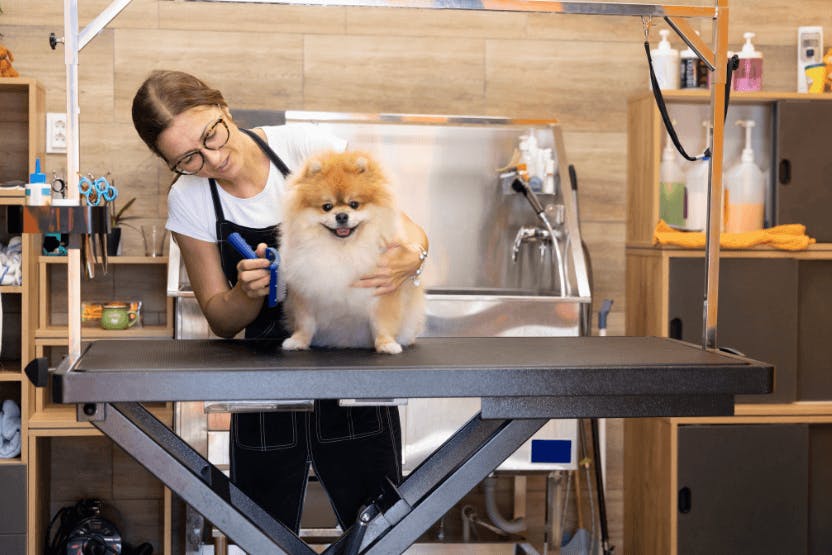
How Home Grooming Differs from Salon Grooming?
According to a large-scale study in the Frontiers in Veterinary Science journal, 41% of dog owners groom their pets' coat at home themselves, 30% choose full salon service, 9% opt for mobile grooming, and 8% use pet store services (PMC9596803, 2022). Most owners intuitively combine both approaches — and that's probably the smartest strategy.
Home grooming covers everything you do yourself: regular brushing, bathing, claw trimming, ear and teeth cleaning. For breeds with short or smooth coats, this is quite sufficient between salon visits — or even instead of them.
Professional salon grooming is a complete cycle of services. Bathing with professional products, drying with pet dryers, breed-standard clipping, trimming, ear and anal gland cleaning, claw processing. Some salons also offer SPA treatments, coloring, and styling. The key point — groomers have equipment that's almost impossible to have at home.
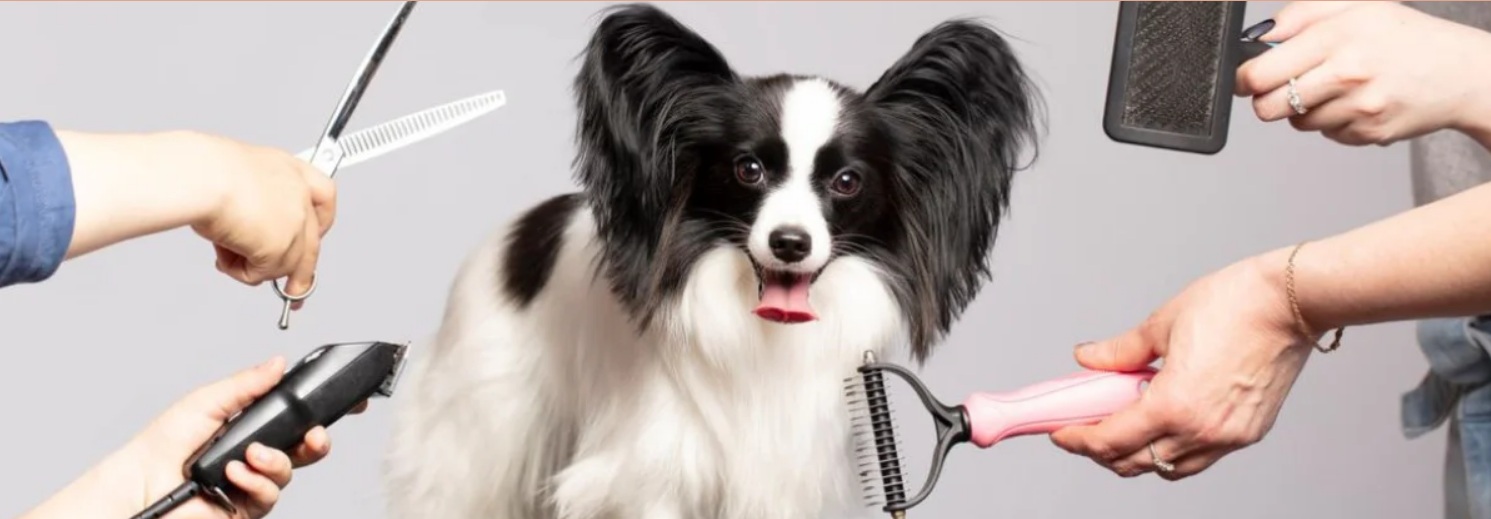
According to the global TGM Research survey of 21,000+ pet owners in 25 countries, including Ukraine, only 15% of pet owners regularly use groomers, while 34% prefer home care (TGM Research, 2024). Despite this, most owners don’t realize that “home” doesn’t always mean “safe.”
How Much Does Home Grooming Cost Compared to a Salon?
Home grooming in the first year costs $150–250 for a full set of tools (clipper, brushing brush, scissors, claw clipper, pet shampoo), and then only $30–50 per year on consumables. A salon session averages $62.50, and most owners visit 5–6 times a year, totaling about $312–375 annually (Thumbtack, 2025). Over 5 years, the difference is striking: $1,950 versus $360.
In Ukraine, salon grooming prices depend on the city and animal size. In Kyiv, a basic session for a small breed dog costs 400–700 UAH, while full grooming for medium or large is 900–2,000 UAH. A basic home kit (clipper + brush + claw clipper) can be bought for 800–2,000 UAH. It pays for itself after 1–3 salon visits and then costs almost nothing. For a spaniel or Shih Tzu owner needing grooming every 6–8 weeks, this saves 3,000 to 10,000 UAH per year.
TGM Research researchers (25 countries, 21,000+ owners) confirm: cost is the main reason why 34% of owners choose home grooming over salons (TGM Research, 2024). However, savings have limits: if you miss a mat or cut a nail wrong, the vet bill could exceed any salon grooming.
Is Home Grooming Safe? What Risks Does Your Pet Face?
Up to 42% of dogs suffer minor injuries during grooming—cuts, damage to the nail quick, scratches, or micro-burns from clippers (Journal of Veterinary Science, 2020). Most cases occur at home when the owner rushes or the pet jerks unexpectedly. This doesn't mean home grooming is inherently dangerous—but it requires preparation and patience.
Most Common Risks in Home Grooming:
- Claws. Cutting the "live" part of the claw (quick) causes severe pain and bleeding. For dark claws, it's very hard to determine the boundary without practice.
- Mattling. Trying to comb or clip an advanced mat can pull the skin under the scissors. According to ASPCA and PMC research, 13% of animal cruelty cases involve strangulation wounds from mats, with 93% of victims being long-haired breeds (PMC8907591, 2022).
- Ears. Improper cleaning or excessive hair removal from the ear canal can injure the ear passage and provoke otitis.
- Overheating. A regular human hairdryer is too hot for an animal's sensitive skin. A special pet dryer with adjustable temperature is needed.
- Eyes. Sharp scissors near the muzzle pose a risk of eye injury with any sudden movement.
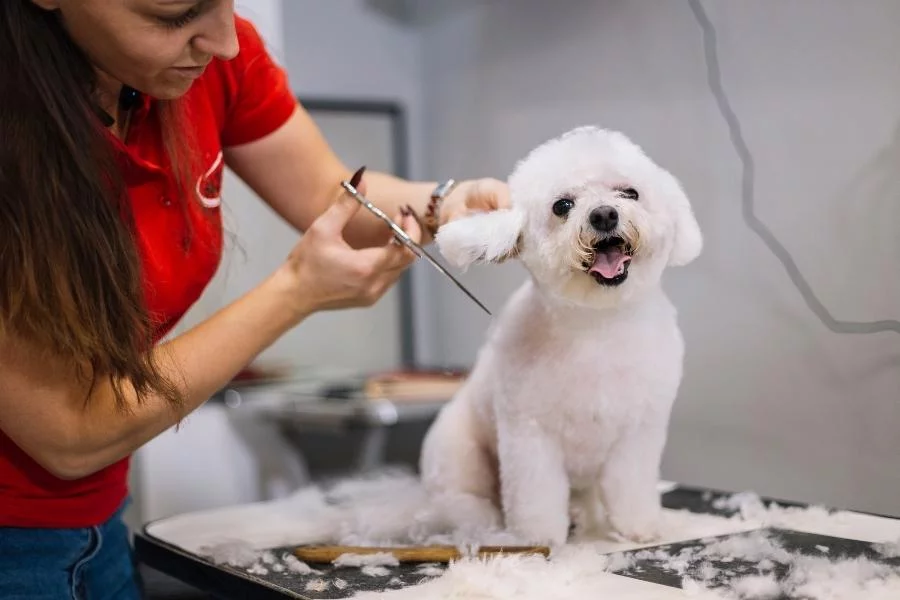
Important to Know: Matting of fur is one of the most dangerous and at the same time most underestimated problems in home grooming. Advanced mats are not only painful: they trap moisture and bacteria, pull the skin, and can lead to severe skin infections. If you can't untangle the mat with your fingers—it's a signal to consult a specialist, not to take scissors yourself.
At the same time, injuries happen in salons too—no one is insured against an animal's unexpected movement. The difference is that an experienced groomer knows how to minimize risks, and proper equipment (non-slip surfaces, restraints, ergonomic table) significantly reduces the likelihood of incidents.
What Benefits Does Professional Grooming Provide for Animal Health?
Experienced groomers detect potential health issues in more than 30% of animals at each visit: skin irritations, subcutaneous lumps, parasites, signs of otitis, paw abnormalities (Direct Animal, 2024). Owners who see their pet daily simply don't notice gradual changes—"the eyes glaze over." The groomer assesses the animal with a fresh, trained eye.
According to ASPCA and Frontiers in Veterinary Science, 6% of veterinary clinic visits are related to medically necessary grooming or overdue nail trims (PMC8907591, 2022). Grooming is not just aesthetics—it's direct health prevention.
Regular grooming is a key part of preventive veterinary care. Groomers detect health problems in over 30% of animals at each visit, while owners observing their pet daily often miss gradual changes (Direct Animal, 2024). This is especially important for breeds with thick undercoats, where skin issues hide deep.
Pay attention to cats. The "cat grooming" category is growing the fastest in the entire market: 19% of cat owners already regularly book their pets with groomers—and this figure is rapidly increasing (GlobalPETS, 2024). This is simply explained: Persians, Maine Coons, and Ragdolls with their luxurious fur require the same level of attention as long-haired dog breeds.
When to Choose Home Grooming vs. When to Go to a Salon?
The right choice depends on four factors: coat type, animal's temperament, your experience level, and procedure frequency. For most breeds, the ideal strategy is combined: daily or weekly home brushing + salon every 4–12 weeks depending on needs. This way, you get both budget control and expert quality where it really matters.
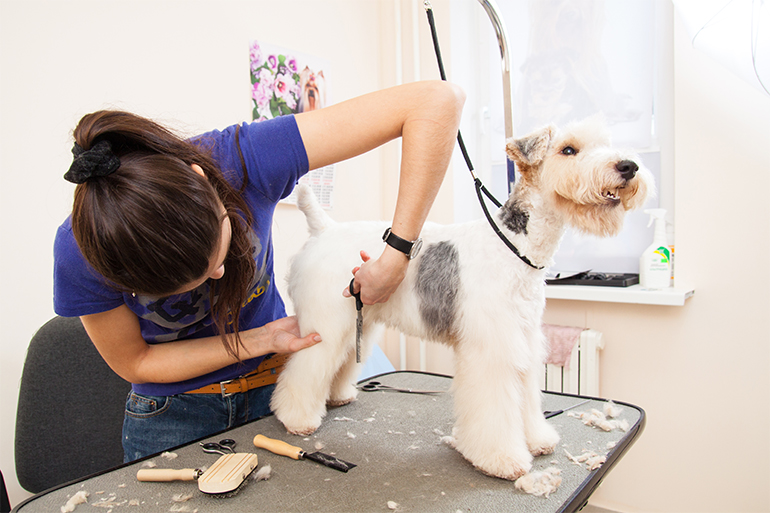
| Situation | Home | Salon |
|---|---|---|
| Short or smooth coat (beagle, boxer, Dalmatian) | ✓ | — |
| Long or curly coat (Yorkshire terrier, Maltese, poodle) | — | ✓ |
| Regular brushing between salon visits | ✓ | — |
| Calm animal accustomed to tools | ✓ | — |
| Nervous, aggressive, or overly active animal | — | ✓ |
| Advanced mats or skin problems | — | ✓ |
| Breed with grooming standard (poodle, Kerry Blue Terrier, Bichon) | — | ✓ |
| Limited budget, simple coat needs | ✓ | — |
For cats, the situation is somewhat different. Most short-haired breeds—British Shorthair, Scottish Fold, regular domestic—handle home care quite independently. They groom themselves, and weekly brushing suffices for the owner. However, Persians, Maine Coons, and Ragdolls require salon grooming every 4–8 weeks. Their fur mats very quickly, and an advanced mat near the skin is already a serious problem that a brush won't solve.
Frequently Asked Questions About Grooming
How often should you bathe a dog?
Most dogs need bathing every 4–8 weeks depending on breed and activity. Breeds with oily skin (Basset Hound, Cocker Spaniel) bathe more often, while those with natural protective oils (Husky, Labrador) less so. Over-bathing destroys the skin's lipid layer, causing dryness and dandruff.
Can you learn to groom a poodle at home?
Technically yes, but without practice, the result will be far from breed standard. Poodles require precise transitions between zones of different lengths. Most owners choose a compromise: bathing and brushing at home, clipping at the salon. Start with simpler breeds before complex clips.
How much does grooming cost in Kyiv in 2026?
Prices vary by animal size and services: 400–700 UAH for bathing and drying a small breed, up to 1,500–2,500 UAH for full grooming a large or thick-coated dog. Mobile grooming is usually 20–30% more expensive than stationary.
Do cats need regular salon grooming?
Short-haired cats mostly self-groom—weekly home brushing suffices. Long-haired breeds (Persian, Maine Coon, Ragdoll) need salon every 4–8 weeks. Notably, 19% of cat owners already regularly book their pets with groomers (GlobalPETS, 2024).
How to know it's time for a groomer?
Clear signs: fur doesn't comb out by hand, mats appear, nails visible or clicking on floor, unpleasant ear smell or dark buildup, fur covering eyes. Self-attempts in these cases can cause more harm than delayed grooming.
Conclusion
Home and salon grooming are not competitors, but partners. Most owners achieve the best results by combining both: daily or weekly home care maintains the coat between visits, while the salon handles complex tasks—clipping, trimming, and health prevention.
Key Takeaways:
-
Up to 42% of home sessions involve minor injuries—be careful with nails and mats.
-
Groomers detect health issues in over 30% of animals—this is prevention, not just clipping.
-
Short-haired and calm animals are ideal for home care. Long-haired, nervous, or show breeds need a pro.
-
Ukraine has 12.5 million pets and a growing grooming market—options in every city.
Whatever you choose, the main thing is regular care for your pet. Clean fur, trimmed nails, and healthy ears are not about beauty—it's about health and quality of life.